
📞 Tel:+86-750-3857665
Email:sales@enpowertec.com
Email:sales@enpowertec.com
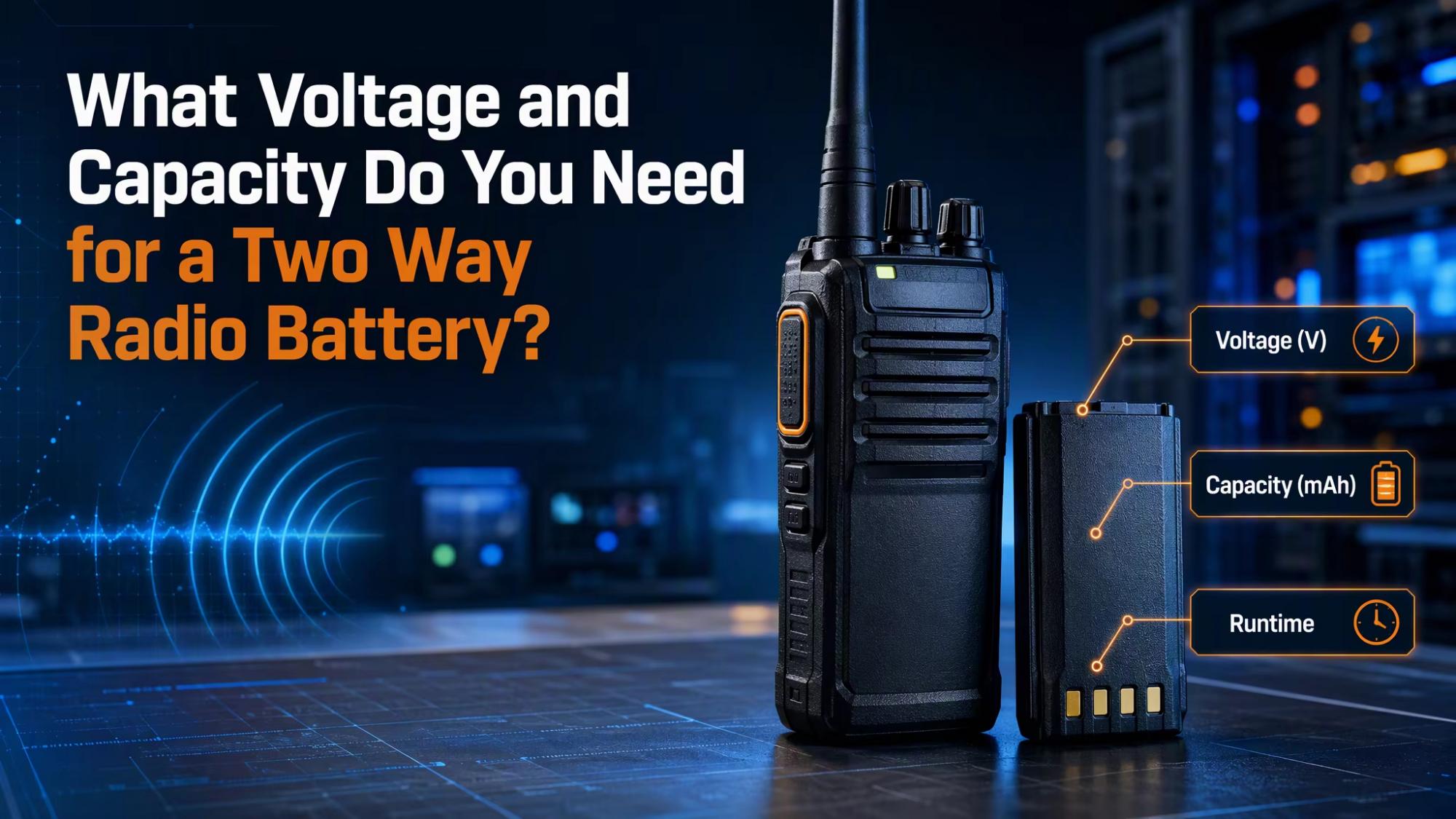
Choosing the correct battery for a two-way radio is essential for maintaining reliable communication performance. Many users focus only on battery capacity, but voltage, capacity, battery chemistry, and compatibility all play important roles in determining whether a battery will work properly.
A wrong battery specification may cause:
Short operating time
Poor radio performance
Charging problems
Battery damage
Equipment downtime
So, what voltage and capacity do you need for a two-way radio battery?
This guide explains how to choose the right voltage and capacity for your professional communication equipment.
A typical two-way radio battery specification includes several important parameters:
Voltage represents the electrical pressure provided by the battery.
Common two-way radio battery voltages include:
3.7V Li-ion battery
7.2V Li-ion / Ni-MH battery
7.4V Li-ion battery
9.6V Ni-MH battery
10.8V Li-ion battery
12V battery packs
The voltage must match the requirements of your radio model.
Using a battery with an incorrect voltage may result in:
Radio malfunction
Insufficient power output
Charging failure
Potential equipment damage
Battery capacity indicates how much energy the battery can store. It is usually measured in:
mAh (milliamp hours)
Ah (amp hours)
For example:
1500mAh battery
2000mAh battery
2500mAh battery
5000mAh battery
A higher capacity battery generally provides longer operating time.
The most important rule: always match the original battery voltage specified by the radio manufacturer.
The voltage is usually printed on:
For example:
| Battery Voltage | Common Application |
|---|---|
| 3.7V | Compact portable radios |
| 7.2V | Many commercial two-way radios |
| 7.4V | Professional Li-ion radio batteries |
| 9.6V | Industrial Ni-MH radio packs |
| 10.8V | Tactical and high-power communication equipment |
A replacement battery should have:
Voltage: 7.4V
Chemistry: Li-ion
Capacity: 2200mAh
Voltage: 7.4V
Chemistry: Li-ion
Capacity: 2200mAh-3000mAh
A different voltage battery should not be used even if the physical size looks similar.
Capacity directly affects how long your radio can operate. A simple example:
Shorter working time
More frequent charging
Longer communication time
Longer shift operation
Reduced charging frequency
The actual runtime depends on:
Different industries have different runtime requirements.
Recommended: 2000mAh-3000mAh
Long working shifts
Continuous communication needs
Reduced downtime
Recommended: 2000mAh-3500mAh
Heavy daily usage
Outdoor working conditions
Extended operation time
Recommended: High-capacity battery packs
4000mAh and above
Multi-cell Li-ion battery solutions
Mission-critical communication
Longer field operation
Reliable power supply
Yes. Different battery technologies provide different performance.
Higher energy density
Lightweight design
Longer runtime
Faster charging
No memory effect
Example: a 7.4V Li-ion battery can provide high capacity while maintaining a compact size.
Stable performance
Good temperature tolerance
Reliable replacement option
Suitable for older radio models
Ni-MH batteries remain popular for many industrial and legacy communication systems.
Many users ask: can I replace my 1500mAh battery with a 2500mAh battery? The answer depends on compatibility.
A higher capacity battery can usually provide longer runtime if:
Voltage is the same
Battery chemistry is compatible
Physical size fits
Charger supports the battery
For example:
7.4V 2000mAh Li-ion battery
7.4V 2500mAh Li-ion battery
This may provide longer working time. However, the battery must still match the radio design requirements.
Before purchasing a replacement battery, check:
Examples:
Motorola series
Kenwood series
HYT / Hytera series
Icom series
Battery labels usually include:
Model number
Voltage
Capacity
Battery chemistry
Check:
Length
Width
Height
Connector position
A battery with incorrect dimensions may not install properly.
Make sure your charger supports:
Some common specifications include:
Voltage: 7.4V
Capacity: 2200mAh
Chemistry: Li-ion
Suitable for
Professional portable radios
Digital communication devices
Voltage: 10.8V
Capacity: 7000mAh
Suitable for
Tactical communication equipment
Military radio systems
Voltage: 7.2V
Capacity: 1800mAh-2500mAh
Chemistry: Ni-MH
Suitable for
Commercial radios
Industrial communication equipment
At Enpower Technology, we specialize in designing and manufacturing customized battery packs for professional communication equipment.
Our solutions include:
Two-way radio batteries
Tactical radio batteries
Industrial communication batteries
Li-ion battery packs
Ni-MH battery packs
We customize batteries according to:
Our battery protection systems include:
Whether you need a replacement battery or a customized battery pack, Enpower provides reliable power solutions for global customers.
Selecting the correct voltage and capacity is the key to choosing the right two-way radio battery. Remember:
For professional users, the right battery means:
Longer communication time
Fewer interruptions
Lower maintenance costs
Better equipment reliability
Need a reliable two-way radio battery replacement or custom battery solution?
Contact Enpower Technology for professional battery design and manufacturing support.

Enpower integrates R&D, production and quality testing in-house, supporting custom battery solutions for worldwide buyers.