
📞 Tel:+86-750-3857665
Email:sales@enpowertec.com
Email:sales@enpowertec.com
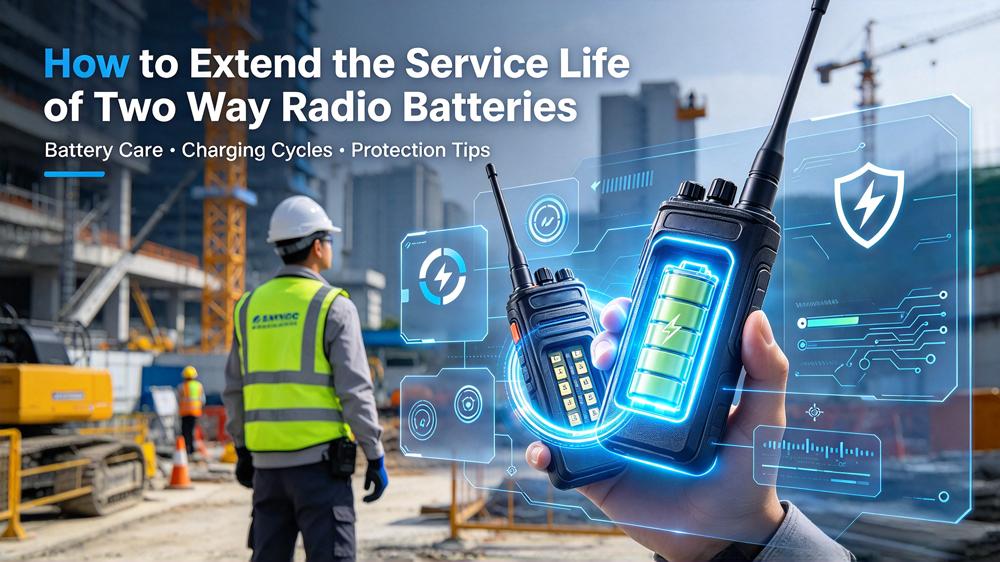
Two-way radios are essential communication tools in industries such as public safety, security, construction, transportation, hospitality, manufacturing, and emergency services.
However, the performance of a two-way radio depends not only on the device itself but also on the condition of its battery. A poorly maintained battery can lead to shorter runtime, unexpected power failures, and increased replacement costs.
So, how can you extend the service life of your two-way radio batteries?
In this guide, we will share practical tips to help you maximize battery performance, reduce maintenance costs, and keep your communication equipment reliable.
Before improving battery life, it is important to understand the battery technology you are using.
The most common two-way radio battery types include:
Li-ion batteries are widely used in modern professional radios because they offer:
High energy density
Lightweight design
Longer operating time
Low self-discharge rate
No memory effect
They are suitable for:
Digital two-way radios
Professional communication systems
Tactical radios
Industrial applications
Ni-MH batteries are commonly used in many industrial and legacy radio systems. Advantages include:
Stable performance
Good safety characteristics
Reliable operation in demanding environments
Cost-effective replacement
Understanding your battery type helps you choose the correct charging and maintenance method.
One of the most common causes of battery aging is improper charging.
Although modern batteries include protection circuits, keeping a battery constantly connected to a charger for long periods may increase heat generation and accelerate capacity loss.
Recommended practices:
Remove the battery from the charger after it reaches full charge when possible
Use the original or compatible charger
Avoid charging batteries in extremely hot environments
Do not leave batteries charging unattended for extended periods
A proper charging routine helps maintain battery health and extends service life.
Using an incompatible charger can damage your two-way radio battery. A suitable charger should match:
For example:
A Li-ion battery requires a Li-ion charging system
A Ni-MH battery requires a Ni-MH compatible charger
Using the wrong charger may cause:
Reduced battery capacity
Shorter runtime
Battery overheating
Safety risks
Always choose chargers designed specifically for your radio battery model.
Many users believe that completely draining a battery before charging improves battery life. This is only true for some older battery technologies.
Avoid frequent deep discharge
Recharge when the battery level reaches around 20-30%
Avoid letting the battery completely run out regularly
Deep discharge may accelerate lithium battery aging.
Occasional full discharge can help reduce memory effect and maintain capacity
Frequent deep discharge is unnecessary and may shorten overall battery life
Follow the maintenance routine recommended for your specific battery chemistry.
Temperature has a major impact on battery performance.
Excessive heat can cause:
Faster chemical aging
Reduced capacity
Shortened battery lifespan
Avoid:
Leaving radios inside vehicles under direct sunlight
Charging batteries near heat sources
Storing batteries in hot areas
Cold environments can temporarily reduce battery performance. In cold conditions:
Battery runtime may decrease
Voltage output may drop
For outdoor industries such as forestry, construction, and emergency services, selecting batteries designed for harsh environments is important.
If a spare radio battery will not be used for a long period, proper storage is essential. Recommended storage conditions:
For long-term storage:
Check battery condition periodically
Recharge when necessary
Avoid storing completely empty batteries
Proper storage can significantly extend battery lifespan.
Poor contact between the battery and radio can cause:
Intermittent power loss
Charging problems
Reduced communication reliability
Regular maintenance:
For industrial environments with dust, moisture, or heavy usage, regular inspection is especially important.
Battery runtime depends not only on battery condition but also on radio usage. To extend operating time:
Reduce unnecessary transmissions
Turn off unused functions
Adjust display brightness when possible
Disable unnecessary accessories
For teams working long shifts, these small adjustments can significantly increase daily operating time.
Even with proper maintenance, every battery eventually reaches the end of its service life. Signs that your two-way radio battery needs replacement:
Shorter operating time
Battery cannot hold a full charge
Unexpected shutdowns
Swollen or damaged battery housing
Increased charging frequency
Choosing a high-quality replacement battery ensures:
At Enpower Technology, we provide professional battery solutions for industrial communication equipment.
Our products include:
Two-way radio batteries
Tactical radio batteries
Industrial communication batteries
Custom Li-ion battery packs
Custom Ni-MH battery packs
We customize battery solutions according to customer requirements, including:
Our battery packs can integrate:
With experienced battery engineers and manufacturing capabilities, Enpower helps customers achieve safer and longer-lasting power solutions.
Extending the service life of a two-way radio battery is not complicated.
By following proper charging habits, controlling temperature, storing batteries correctly, and choosing quality replacement batteries, you can:
Whether you use Li-ion or Ni-MH batteries, proper maintenance is the key to maximizing performance.
Looking for reliable two-way radio battery replacements or custom battery solutions?
Contact Enpower Technology for professional battery manufacturing support.

Enpower integrates R&D, production and quality testing in-house, supporting custom battery solutions for worldwide buyers.