
📞 Tel:+86-750-3857665
Email:sales@enpowertec.com
Email:sales@enpowertec.com
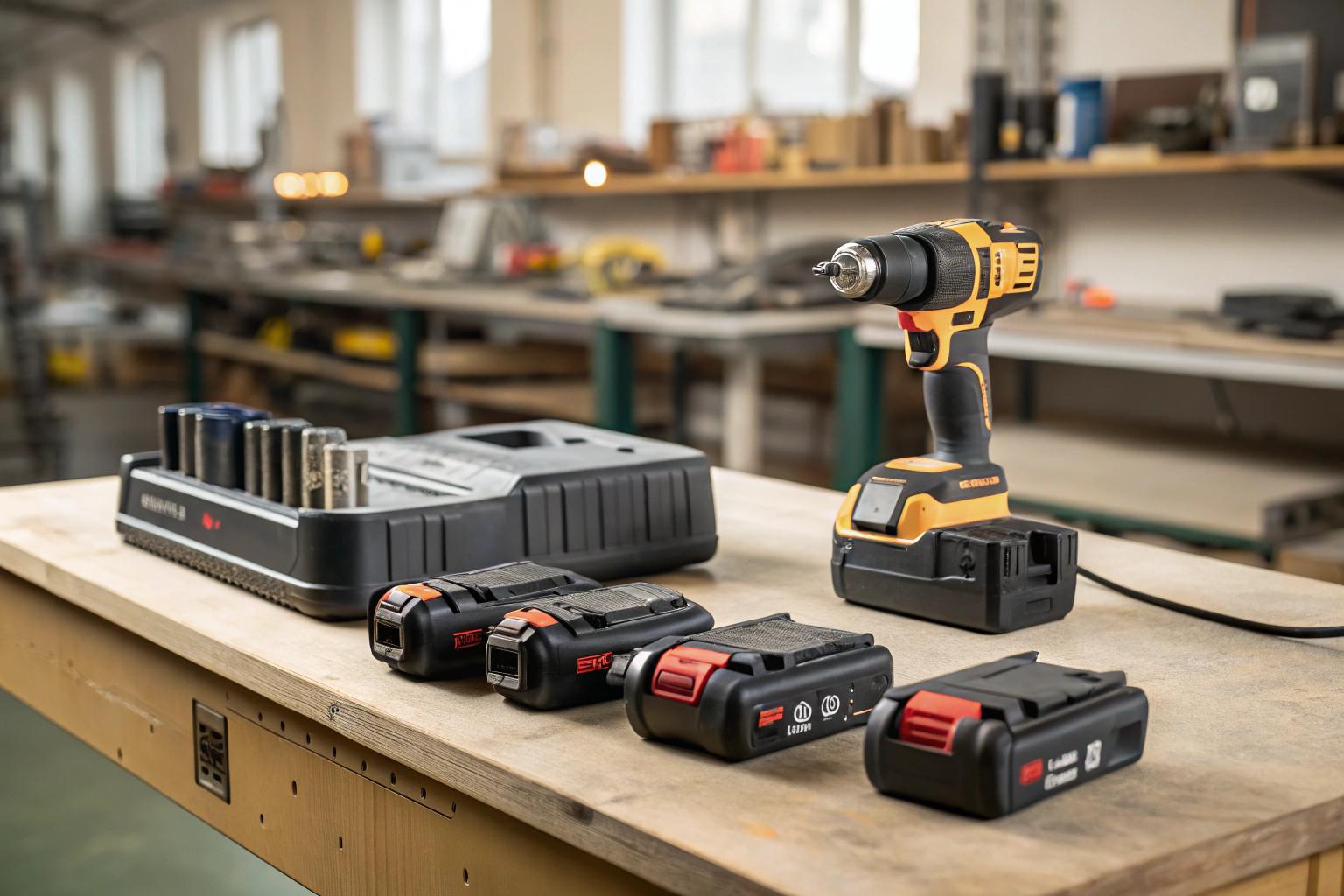
Power tool batteries play an important role in determining the performance, runtime, and reliability of cordless tools. Among traditional rechargeable battery technologies, Nickel-Metal Hydride (Ni-MH) and Nickel-Cadmium (Ni-Cd) batteries have been widely used in cordless drills, screwdrivers, saws, and other industrial power tools.
Although lithium-ion batteries have become increasingly popular, Ni-MH and Ni-Cd batteries remain relevant in replacement battery markets, especially for older power tools and equipment that require specific battery compatibility.
So, what is the difference between Ni-MH and Ni-Cd power tool batteries? Which one is better for your application? This guide explains their main differences and helps businesses choose the right replacement battery. For an overview of the packs we supply, see our Power Tool Batteries range.
Before comparing their performance, it is important to understand how these two battery technologies work.
Nickel-Metal Hydride (Ni-MH) batteries are rechargeable batteries that use a hydrogen-absorbing alloy as the negative electrode and nickel oxyhydroxide as the positive electrode.
Compared with traditional Ni-Cd batteries, Ni-MH batteries generally offer higher energy density and greater capacity in a similar battery size.
Key features include:
Higher energy density than traditional Ni-Cd batteries.
Higher capacity options for longer operating time.
No intentionally added cadmium.
Suitable for cordless drills and other rechargeable power tools.
Available in various battery pack configurations and voltages.
Ni-MH batteries are commonly used as replacement batteries for older cordless power tools where the original battery specifications support Ni-MH technology.
Nickel-Cadmium (Ni-Cd) batteries are one of the earliest rechargeable battery technologies used in cordless power tools.
They are known for their durability, reliable discharge performance, and ability to operate under demanding conditions.
Key features include:
Good high-current discharge capability.
Reliable performance in demanding applications.
Relatively robust cycle performance when properly maintained.
Good tolerance for certain operating conditions.
Established compatibility with many older cordless tools.
Although both battery types use nickel-based chemistry, they have different performance characteristics.
| Comparison | Ni-MH Battery | Ni-Cd Battery |
|---|---|---|
| Energy Density | Generally higher | Generally lower |
| Capacity | Usually higher | Usually lower |
| Discharge Performance | Good | Excellent for high-current applications |
| Memory Effect | Lower, but voltage depression can occur | More noticeable under certain charging conditions |
| Self-Discharge | Generally higher | Generally lower |
| Environmental Impact | No intentionally added cadmium | Contains toxic cadmium |
| Maintenance | Requires proper charging | Requires proper charging |
| Applications | Replacement power tool batteries | Older cordless tools and industrial equipment |
Battery capacity directly affects how long a cordless power tool can operate before needing to recharge.
Ni-MH batteries generally provide higher energy density than traditional Ni-Cd batteries. This means they can often store more energy within a similar battery size.
For example, a higher-capacity Ni-MH replacement battery may provide longer operating time than an older Ni-Cd battery, provided that the tool supports the replacement specifications.
However, capacity is not the only factor to consider.
When selecting a replacement power tool battery, buyers should check:
Rated voltage (V)
Nominal capacity (mAh or Ah)
Continuous discharge current
Peak discharge current
Battery dimensions
Connector and terminal design
Power tools often require high current, especially when starting a motor, drilling into hard materials, or performing heavy-duty cutting tasks.
Ni-Cd batteries have traditionally been valued for their strong high-current discharge performance and ability to handle demanding applications.
Ni-MH batteries can also deliver good discharge performance, but their suitability depends on the specific cell design and discharge rating.
For applications requiring high startup current, buyers should not compare batteries based on capacity alone. Instead, evaluate:
Memory effect is a commonly discussed issue with nickel-based rechargeable batteries.
Ni-Cd batteries can experience noticeable voltage depression when repeatedly recharged after only partial discharge under certain conditions.
Ni-MH batteries are generally less susceptible to this issue, although they can also experience voltage depression and capacity loss under unfavorable charging and usage conditions.
Both battery types require compatible chargers. Important charging considerations include:
Use a charger designed for the specific battery chemistry.
Follow the recommended charging voltage and current.
Avoid prolonged exposure to excessive temperatures.
Do not use a Ni-Cd charger for Ni-MH batteries unless the charger manufacturer explicitly confirms compatibility.
Inspect batteries regularly for swelling, leakage, or physical damage.
Environmental impact is another important difference between Ni-MH and Ni-Cd batteries.
Ni-Cd batteries contain cadmium, a toxic heavy metal that requires careful handling and specialized recycling.
Ni-MH batteries do not intentionally use cadmium, making them a more environmentally favorable alternative in this respect.
For businesses purchasing replacement batteries, environmental regulations should be considered when selecting battery chemistry and planning battery disposal.
The best battery depends on your equipment, operating conditions, and replacement requirements.
You need a replacement battery with higher capacity options.
Your cordless tool supports Ni-MH battery chemistry.
You want to replace an older battery with a cadmium-free alternative.
You need a suitable balance of capacity and operating time.
Your equipment is compatible with the voltage, dimensions, and connector configuration.
Your original equipment specifically requires Ni-Cd chemistry.
Your application depends on an established Ni-Cd battery configuration.
Your equipment manufacturer specifies Ni-Cd charging and discharge characteristics.
You need to maintain compatibility with older industrial power tools.
Always verify the original battery specifications and charger compatibility before replacement.
For distributors, wholesalers, repair companies, and industrial equipment suppliers, choosing the right replacement battery involves more than matching the voltage and capacity.
Here are five important factors to check.
Make sure the replacement battery matches the rated voltage required by the power tool.
Choose an appropriate capacity based on the required operating time and available battery space.
Check the battery length, width, height, housing design, and installation position.
Verify the terminal arrangement, connector type, and electrical connection.
Confirm that the replacement battery chemistry and charging specifications are supported by the existing charger.
Enpower Technology Co., Ltd. specializes in rechargeable battery pack manufacturing and customized battery solutions for industrial and commercial applications.
We provide battery solutions for different equipment categories, including cordless power tools, two-way radios, crane remote controls, barcode scanners, and energy storage applications.
Our battery customization capabilities include:
Ni-MH, Li-ion, and LiFePO4 battery solutions.
Customized voltage and capacity configurations.
Battery pack structure and dimensional customization.
Customized connectors and terminal designs.
Overcharge, over-discharge, over-current, and short-circuit protection where applicable.
Temperature monitoring and protection solutions based on battery design.
Whether you are sourcing replacement batteries for older cordless drills or developing customized battery packs for industrial equipment, Enpower can help evaluate your requirements and develop suitable battery solutions.
Contact our team to discuss your battery specifications, OEM requirements, and wholesale purchasing needs.
Ni-MH batteries generally offer higher energy density and capacity, while Ni-Cd batteries are known for strong high-current discharge performance. The better option depends on the power tool's compatibility and operating requirements.
Not always. The voltage, dimensions, connector, discharge requirements, and charger compatibility must all be checked before replacement.
Ni-MH batteries are generally less susceptible to the traditional memory effect than Ni-Cd batteries. However, they may still experience voltage depression and capacity deterioration under certain operating conditions.
There is no universal answer. Actual service life depends on cell quality, charging methods, discharge depth, operating temperature, and maintenance.
Ni-MH batteries do not intentionally contain cadmium, making them a preferable option in this respect. However, they still require proper collection and recycling.
Both Ni-MH and Ni-Cd batteries have important roles in the power tool replacement battery market.
Ni-MH batteries offer higher energy density, more capacity options, and reduced cadmium-related environmental concerns. Ni-Cd batteries remain useful for older equipment and applications requiring their established discharge characteristics.
For buyers, the most important consideration is not simply choosing the newest battery technology. It is selecting a battery that matches the equipment's electrical, mechanical, and charging requirements.
Visit our website: https://www.enpowertec.com/
Contact our team for OEM/ODM battery manufacturing and customized battery solutions.

Enpower integrates R&D, production and quality testing in-house, supporting custom battery solutions for worldwide buyers.