
📞 Tel:+86-750-3857665
Email:sales@enpowertec.com
Email:sales@enpowertec.com
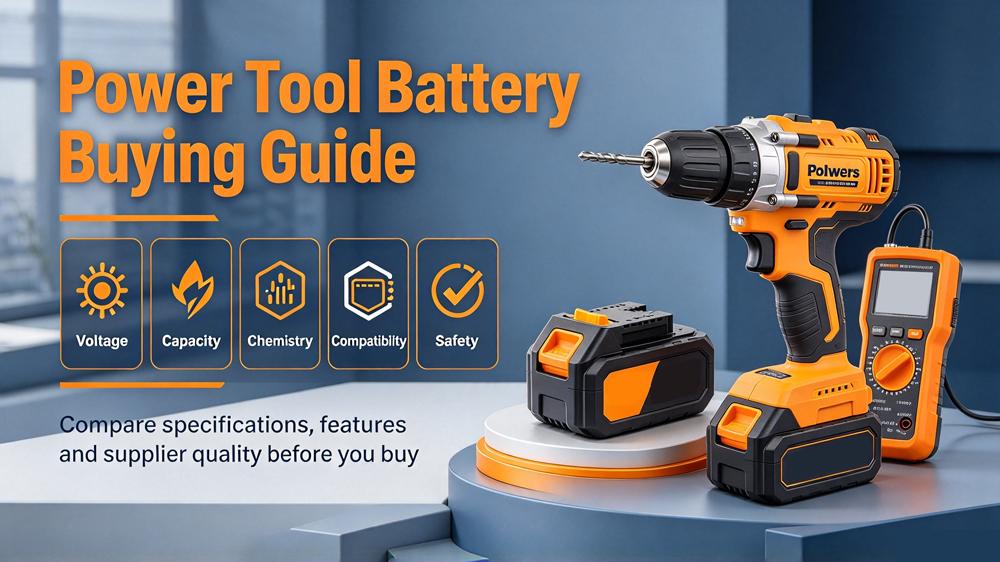
A reliable power tool battery is essential for maintaining productivity, reducing downtime, and ensuring consistent performance on the job. Whether you are a professional contractor, equipment distributor, tool repair company, or industrial buyer, choosing the right replacement power tool battery can help extend equipment service life and improve operational efficiency.
However, with different battery voltages, capacities, chemistries, sizes, and connector designs available, finding the right replacement is not always straightforward.
In this guide, we will explain the key factors to consider when choosing a replacement power tool battery and how to identify a suitable solution for your equipment. You can also browse our full range of Power Tool Batteries for product-level reference.
Voltage is one of the most important specifications when selecting a replacement power tool battery. It determines whether the battery is electrically compatible with your power tool.
Common power tool battery voltages include:
Used in some compact cordless tools and portable devices.
Common in selected cordless screwdrivers and compact power tools.
Frequently used in compact drills, drivers, and lightweight cordless tools.
Found in various cordless drills and professional power tools.
Widely used in cordless drills, impact drivers, saws, and other professional tools.
Used in selected high-power tools and outdoor equipment.
When choosing a replacement battery, always check the voltage specified on the original battery and in the tool manufacturer's documentation.
Battery capacity affects how long a power tool can operate before the battery needs recharging. It is usually measured in ampere-hours (Ah) or milliampere-hours (mAh).
For example:
Suitable for lighter applications where lower weight is important.
A practical option for many everyday professional applications.
Often preferred for extended operating time and demanding workloads, provided the battery is compatible with the tool.
In general, a higher-capacity battery can provide longer operating time under comparable conditions. However, actual runtime depends on the tool's power consumption, workload, operating environment, battery condition, and temperature.
Battery chemistry influences energy density, charging characteristics, weight, service life, and operating requirements.
The most common options for power tool battery replacement include lithium-ion, nickel-metal hydride, and nickel-cadmium.
Lithium-ion batteries are widely used in modern cordless power tools. Key advantages include:
High energy density relative to many traditional rechargeable battery chemistries.
Lower weight for comparable energy capacity in many designs.
Low self-discharge when properly designed and stored.
No significant memory effect under normal operating conditions.
Ni-MH batteries are found in some older power tools and other rechargeable equipment. Their characteristics include:
Compatibility with certain legacy battery platforms.
Rechargeable operation.
Different voltage, capacity, and charging requirements from lithium-ion batteries.
Ni-Cd batteries are used in some older cordless power tools and industrial equipment.
They can offer robust performance in certain applications, but cadmium presents environmental and disposal concerns. Regulations governing their sale and use also vary by market.
When replacing an older Ni-Cd battery, confirm whether the original chemistry must be retained or whether an engineered alternative is available for the specific tool.
Compatibility is one of the most common challenges when purchasing replacement power tool batteries.
Two batteries may have identical voltage and capacity but still be incompatible because of differences in their mechanical design or electrical interfaces.
Before placing an order, check the following details.
Locate the model number printed on the original battery. This information is often the fastest way to identify a suitable replacement.
Record the power tool brand, model number, and, where relevant, the battery platform or generation.
Compare the battery's physical dimensions, terminal arrangement, mounting structure, and locking mechanism.
Some battery platforms use communication contacts, temperature-sensing terminals, or electronic identification features in addition to the main positive and negative terminals. A replacement battery must meet the equipment's relevant electrical and communication requirements.
Check whether the original charger supports the replacement battery's chemistry, voltage, and charging specifications. A battery that physically fits a tool is not necessarily electrically compatible with it or its charger.
A power tool battery must deliver reliable performance under changing workloads and operating conditions.
When comparing replacement battery packs, consider the following quality factors.
Battery cells influence capacity, discharge capability, consistency, and service life.
Depending on the design, battery packs may require protection against overcharge, over-discharge, overcurrent, short circuits, and abnormal temperatures.
Appropriate cell arrangement, materials, and thermal design help manage heat generated during charging and discharging.
The battery enclosure should be designed for the intended environment, including the mechanical stresses associated with normal tool use.
Controlled assembly processes, inspection procedures, and appropriate testing help improve product consistency between batches.
Clear model identification, technical specifications, and quality records help business buyers manage inventory and supplier performance.
When the original battery is no longer available, a compatible replacement can be a practical option for maintaining existing equipment.
However, buyers should evaluate more than the purchase price.
| Evaluation Factor | Original Battery | Third-Party Replacement Battery |
|---|---|---|
| Compatibility | Designed for its specified platform | Must be verified for the exact tool and battery system |
| Availability | Depends on the brand and product lifecycle | May offer additional options for discontinued models |
| Price | Varies by brand and model | Varies by supplier, cell selection, and design |
| Specifications | Provided by the original manufacturer | Should be supported by clear technical documentation |
| Customization | Generally limited to the original product range | Some manufacturers offer customized battery pack solutions |
| Warranty | Depends on the original manufacturer's terms | Depends on the replacement supplier's warranty policy |
The right replacement battery depends on how and where the power tool will be used.
Construction professionals often need dependable runtime and batteries that can withstand the normal mechanical demands of job-site use. Capacity, housing durability, charging availability, and compatibility with existing tools are important considerations.
Maintenance teams may operate cordless drills, drivers, and other tools throughout the working day. Consistent battery availability, predictable performance, and reliable replacement sourcing can help minimize equipment downtime.
Automotive technicians may rely on cordless impact drivers, drills, and other battery-powered tools. Battery capacity, discharge capability, and compatibility with the tool's operating requirements are important when selecting a replacement.
Some cordless outdoor tools require higher power output or longer operating time. Buyers should check the battery platform, environmental requirements, operating temperature range, and manufacturer specifications before selecting a replacement.
For wholesalers, distributors, importers, and equipment repair companies, choosing a dependable battery manufacturer is just as important as choosing the battery itself.
A reliable supplier should provide clear technical information, consistent production quality, responsive communication, and appropriate after-sales support.
When evaluating a power tool battery manufacturer, consider these factors:
Can the supplier support your required battery models, specifications, and order quantities?
Can the supplier help verify voltage, capacity, cell configuration, dimensions, connectors, and charging requirements?
Are suitable inspection and testing procedures applied during battery pack production?
Can the manufacturer develop battery packs for specific equipment or special requirements?
Can the supplier support repeat orders and maintain consistent product specifications?
Can the supplier provide timely technical information and assistance with compatibility questions?
Standard replacement batteries may not be suitable for every application, particularly when the original battery has been discontinued or the equipment requires a specific battery configuration.
A customized battery pack may be worth considering when:
The original battery is difficult to source.
A specific voltage or capacity is required.
The equipment has special dimensional or connector requirements.
The application requires defined continuous or peak discharge performance.
A business needs a replacement solution for a specialized tool or equipment platform.
Depending on the project, customization may involve cell selection, pack dimensions, connector design, protection circuitry, charging parameters, and enclosure requirements.
A practical development process includes collecting the original battery specifications, confirming the equipment requirements, evaluating a proposed design, testing samples, and validating compatibility before mass production.
Before purchasing a replacement power tool battery, use this checklist to verify the key requirements.
Choosing the right replacement power tool battery requires more than matching voltage or selecting a higher capacity. Battery chemistry, physical dimensions, connectors, charging requirements, protection features, and application conditions all influence whether a replacement is suitable.
For individual users, verifying the original battery model and equipment compatibility is a sensible starting point. For distributors, repair companies, and industrial buyers, working with an experienced battery manufacturer can help simplify sourcing and support more specialized requirements.
Enpower Technology Co., Ltd. provides battery pack manufacturing solutions for different applications, including power tool batteries and customized battery pack projects. By evaluating the equipment requirements and target specifications, buyers can identify a more suitable replacement solution for their business.

Enpower integrates R&D, production and quality testing in-house, supporting custom battery solutions for worldwide buyers.