
📞 Tel:+86-750-3857665
Email:sales@enpowertec.com
Email:sales@enpowertec.com
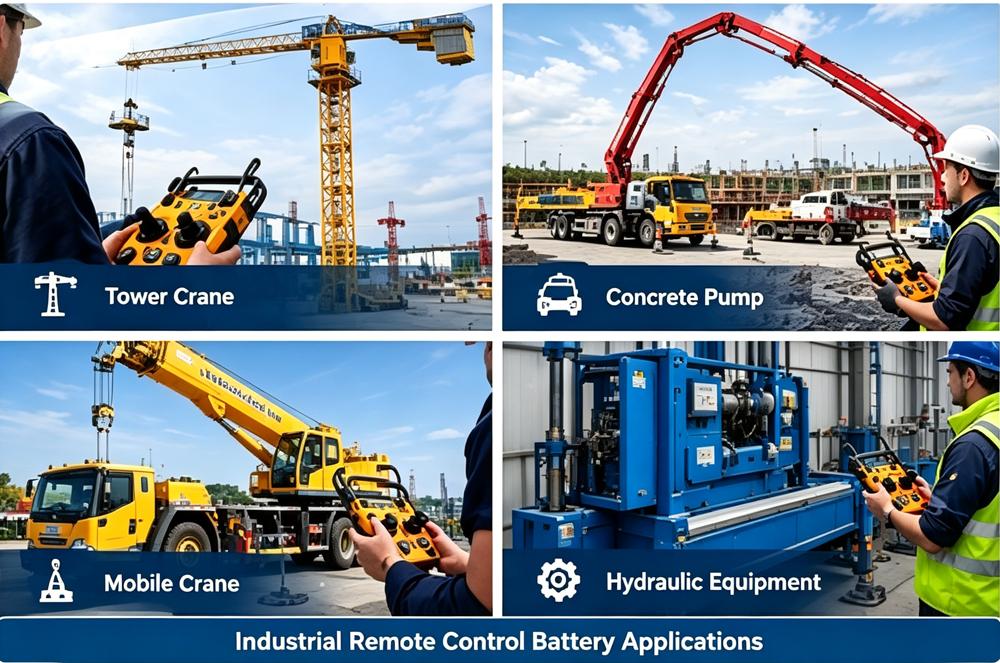
Industrial remote control systems play an essential role in modern manufacturing, material handling, construction, forestry, and other industrial applications. From overhead cranes and concrete pumps to hydraulic machinery and industrial lifting equipment, reliable wireless control helps operators manage equipment efficiently.
Behind every reliable industrial remote control is a suitable battery. Choosing the wrong battery can lead to shorter operating time, charging problems, compatibility issues, and unexpected equipment downtime.
For equipment manufacturers, maintenance companies, distributors, and industrial purchasing managers, understanding how to select the right industrial remote control battery is essential.
In this complete buyer's guide, we explain the different battery types, key specifications, compatibility requirements, charging considerations, and factors to evaluate when choosing an industrial remote control battery supplier.
An industrial remote control battery is a rechargeable or replaceable battery pack designed to power wireless transmitters used to operate industrial equipment.
Unlike many consumer electronics batteries, industrial remote control batteries may need to support frequent operation, demanding working environments, and specific equipment compatibility requirements.
Typical applications include:
Overhead crane and bridge crane remote controls.
Mobile crane and folding boom crane remote controls.
Concrete pump remote controls.
Forestry machinery and log-grabbing equipment.
Industrial lifting and material handling systems.
Hydraulic equipment and machinery control systems.
Other industrial wireless control devices.
These applications have different power requirements, battery dimensions, connectors, and charging systems. Therefore, selecting a suitable industrial remote control battery requires more than simply matching the voltage.
Industrial remote control battery packs are available in several chemistries. The appropriate option depends on the original equipment specifications, operating requirements, and charging system.
Nickel-metal hydride (Ni-MH) batteries are used in many industrial rechargeable battery packs, including certain crane remote control systems.
Key characteristics include:
Rechargeable battery technology.
Availability in various voltage and capacity configurations.
Suitability for compatible industrial remote control applications.
Charging and storage requirements specific to Ni-MH chemistry.
Ni-MH batteries can be a practical replacement option when the original remote control is designed for this chemistry. Buyers should confirm the battery voltage, capacity, connector, dimensions, and charger compatibility before ordering.
Nickel-cadmium (Ni-Cd) batteries are found in some older industrial remote control systems. They have historically been used in rechargeable battery packs for equipment requiring dependable operation. However, cadmium presents environmental and health hazards, and its use and disposal are subject to restrictions in many markets.
When replacing a legacy Ni-Cd battery, check whether the original battery must be retained or whether an approved alternative is available.
Lithium-ion (Li-ion) batteries offer high energy density and generally low self-discharge, making them suitable for many compact rechargeable battery applications.
Depending on the design, a Li-ion battery pack may provide:
A compact, lightweight configuration.
Different voltage and capacity options.
Protection features designed for the battery pack.
Potentially longer operating time when appropriately sized for the application.
However, Li-ion batteries require compatible charging equipment and suitable protection and temperature management.
| Feature | Ni-MH | Ni-Cd | Li-ion |
|---|---|---|---|
| Rechargeable | Yes | Yes | Yes |
| Energy density | Moderate | Generally lower | Generally higher |
| Self-discharge | Chemistry-dependent; can be relatively high | Chemistry-dependent | Generally low |
| Charging requirements | Ni-MH-compatible charger | Ni-Cd-compatible charger | Charger compatible with the specific Li-ion pack |
| Common consideration | Charging and storage management | Environmental and disposal restrictions | Protection, charging, and temperature requirements |
Before purchasing an industrial remote control battery, buyers should verify the following technical specifications.
Voltage is one of the most important compatibility factors.
Industrial remote control batteries are available in different nominal voltages, depending on the battery chemistry and cell configuration. Common examples include 3.6V, 6V, and 7.2V packs, although actual requirements vary by equipment.
Check the nominal voltage stated on the original battery label or in the equipment documentation.
Battery capacity is generally expressed in milliamp-hours (mAh) or amp-hours (Ah). Capacity affects how much charge a battery can store and can influence the operating time between charges.
When evaluating capacity, consider:
The original battery's rated capacity.
Expected daily operating hours.
The frequency of charging.
The remote control's power consumption.
Available space for the battery pack.
The replacement battery must fit correctly into the remote control. Measure the original battery's length, width, and height. Also check the shape of the housing, the location of the contacts, and the battery compartment's locking mechanism.
Industrial remote control batteries may use model-specific connectors and terminal arrangements. Before ordering, confirm:
Connector type and shape.
Number and arrangement of pins.
Terminal polarity.
Contact spacing.
Any additional temperature-sensing or identification connections.
Confirm whether the original battery uses Ni-MH, Ni-Cd, Li-ion, or another chemistry. Battery chemistry determines charging requirements and affects the appropriate operating and storage procedures.
Selecting the right battery starts with identifying the actual equipment requirements. Follow these steps to reduce the risk of ordering an incompatible product.
Record the manufacturer, remote control model, and original battery part number. These details help narrow down compatible replacements.
Look for the voltage, capacity, chemistry, model number, and other technical information.
Compare the battery dimensions, connector, terminal arrangement, and installation method.
Confirm that the existing charger is approved for the replacement battery's chemistry and charging specifications.
Consider temperature, humidity, dust, vibration, and the equipment's daily operating schedule.
If any specification is unclear, send the battery supplier clear photographs of the original battery label, connector, and remote control model.
A suitable battery charger is essential for maintaining battery performance and safety. Different battery chemistries use different charging methods. Using an incompatible charger can cause charging failures, excessive heat, or battery damage.
Before charging an industrial remote control battery:
Use a charger approved for the specific battery pack.
Follow the manufacturer's charging instructions.
Avoid damaged charging cables and connectors.
Keep charging contacts clean and dry.
Do not charge batteries outside their specified temperature range.
For Li-ion battery packs, the charger must match the pack's specified charging requirements. For Ni-MH batteries, the charging method and termination system must also be suitable for the battery.
Proper battery maintenance can help reduce premature aging and improve operating reliability.
Do not routinely drain a rechargeable battery completely before recharging it. In particular, avoid leaving Li-ion batteries fully discharged for extended periods. Follow the manufacturer's recommendations for the specific battery chemistry.
Keep batteries in a cool, dry environment within the manufacturer's recommended storage temperature range. For extended storage, follow the recommended charge level and inspection schedule.
Dust, moisture, and corrosion can interfere with electrical connections. Inspect the battery contacts regularly and clean them using an approved method.
High temperatures can accelerate battery aging, while low temperatures may temporarily reduce available capacity. Observe the operating and charging temperature limits specified for the battery pack.
Monitor operating time, charging behavior, and physical condition. Replace batteries that no longer provide reliable operation or that show signs of damage.
A rechargeable battery gradually loses capacity through normal use and aging. Recognizing the warning signs can help maintenance teams identify problems before they interrupt operations.
Common indicators include:
Shorter operating time: The remote control runs for significantly less time after charging.
Frequent low-battery warnings: Battery level warnings appear earlier than expected.
Unexpected shutdowns: The remote control loses power during normal use.
Charging problems: The battery fails to charge properly using a compatible charger.
Physical damage: The housing is cracked, swollen, or leaking.
Unusual heating: The battery becomes excessively hot during charging or operation.
Industrial buyers often need to choose between an original equipment manufacturer (OEM) battery and a compatible replacement battery. Both options can be appropriate, depending on the application and purchasing requirements.
| Factor | Original OEM battery | Compatible replacement battery |
|---|---|---|
| Product identification | Usually specified by the original equipment manufacturer | Must be verified against original specifications |
| Compatibility | Intended for the specified equipment | Depends on confirmed technical compatibility |
| Customization | Depends on the OEM's product range | May be available from specialist battery manufacturers |
| Sourcing | Depends on the original supply channel | May offer additional sourcing options |
| Evaluation priority | Original specification and support | Compatibility, quality, testing, warranty, and total cost |
For distributors, equipment repair companies, and industrial maintenance teams, important considerations include product consistency, technical documentation, quality control, warranty terms, and long-term supply availability.
When evaluating a replacement supplier, ask for the specifications and test information relevant to your application.
Choosing a reliable manufacturer is important for businesses that purchase industrial batteries regularly or require customized battery packs. Consider the following factors when evaluating a supplier.
Look for a manufacturer with experience in battery pack assembly, electrical connections, housing integration, and application-specific battery requirements.
Ask about incoming material inspection, assembly controls, electrical testing, and final product inspection. The appropriate tests depend on the product design and intended application.
Some industrial applications require specific voltage, capacity, dimensions, connectors, discharge characteristics, or protection functions. A manufacturer with suitable engineering capabilities may be able to assess these requirements and develop a compatible solution.
A supplier should be able to help review the original battery specifications, charger requirements, and compatibility questions before production or shipment.
Confirm warranty coverage, product traceability, replacement procedures, and the availability of technical assistance.
Standard replacement batteries may not meet every industrial application's requirements. For equipment manufacturers, system integrators, and specialized industrial users, customized battery packs can be considered when the application requires specific electrical or mechanical characteristics.
Depending on the project, customization requirements may include:
A custom battery project should begin with a clear set of technical requirements. The battery manufacturer can then evaluate feasibility, propose a suitable design, and conduct appropriate sample testing before mass production.
Enpower Technology specializes in industrial battery solutions for a range of equipment applications, including crane remote controls and other industrial devices.
For battery distributors, equipment maintenance companies, system integrators, and OEM customers, finding the right battery involves more than matching voltage. Connector compatibility, charging requirements, physical dimensions, and operating conditions must also be considered.
Enpower can review customer requirements for suitable replacement and customized battery solutions, subject to product compatibility and project evaluation.
When contacting our team, please provide the following information whenever available:
Providing accurate information helps our team evaluate your application and identify the specifications that need to be confirmed.
Industrial remote controls may use Ni-MH, Ni-Cd in some legacy systems, Li-ion, or other battery technologies. The correct type depends on the original equipment specifications and compatible charging system.
Start with the original battery model number and remote control model. Confirm voltage, capacity, chemistry, dimensions, connector configuration, and charger compatibility before ordering.
Potentially, provided that the replacement meets the equipment's electrical and physical requirements and is compatible with the charging system. A higher capacity does not automatically mean the battery is suitable.
Service life depends on battery chemistry, product quality, charging frequency, operating temperature, storage conditions, and usage patterns. Follow the manufacturer's maintenance recommendations and replace batteries when performance becomes unreliable.
Some manufacturers can customize voltage, capacity, dimensions, connectors, housing, and protection features, depending on technical feasibility and application requirements. A project evaluation is normally needed before confirming the final design.
Provide the original battery model, remote control model, voltage, capacity, chemistry, dimensions, connector photographs, required quantity, and any special operating requirements. This information helps the supplier assess compatibility and prepare a more accurate quotation.
Choosing the right industrial remote control battery requires careful consideration of battery chemistry, voltage, capacity, dimensions, connectors, charging requirements, and working conditions.
By confirming these specifications before purchasing, industrial buyers can reduce compatibility risks, improve maintenance planning, and support reliable equipment operation.
Whether you need a standard replacement battery or a customized industrial battery pack, working with an experienced supplier can make the sourcing process more efficient.

Enpower integrates R&D, production and quality testing in-house, supporting custom battery solutions for worldwide buyers.