
📞 Tel:+86-750-3857665
Email:sales@enpowertec.com
Email:sales@enpowertec.com
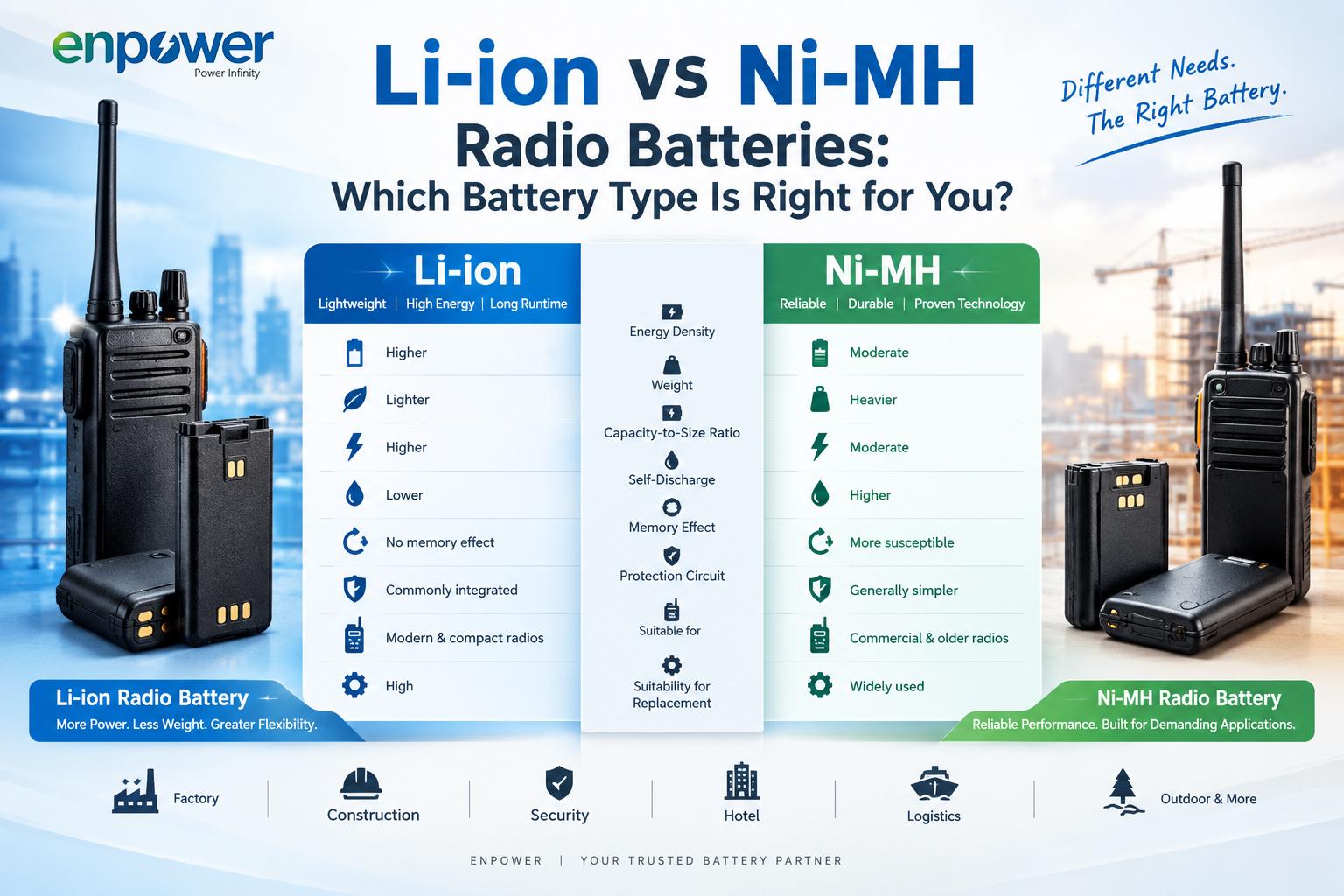
Choosing the right battery is essential for keeping two-way radios reliable and ready for use. Different radio applications have different requirements for runtime, weight, charging, durability, and operating conditions.
Two of the most common rechargeable battery technologies used in professional two-way radios are Lithium-ion (Li-ion) and Nickel-Metal Hydride (Ni-MH).
So, which battery type is right for your radio?
The answer depends on your equipment, working environment, operating time, and performance requirements. This guide explains the key differences between Li-ion and Ni-MH radio batteries to help you make a more informed choice.
Lithium-ion batteries are widely used in modern portable electronic equipment because they offer high energy density and relatively low weight.
For two-way radios, Li-ion battery packs can provide a good balance between battery capacity, runtime, and portability.
Li-ion batteries are commonly selected when users need longer operating time without significantly increasing the size or weight of the radio battery.
Nickel-Metal Hydride (Ni-MH) batteries have been widely used in professional communication equipment for many years.
Ni-MH technology is particularly common in replacement batteries for commercial two-way radios and older radio models.
For some radio models, Ni-MH remains a practical choice, especially when the original equipment was designed around Ni-MH battery technology.
Understanding the differences between the two technologies can help you select the appropriate battery for your radio.
| Feature | Li-ion | Ni-MH |
|---|---|---|
| Energy density | High | Moderate |
| Weight | Generally lighter | Generally heavier |
| Capacity-to-size ratio | High | Moderate |
| Self-discharge | Low | Higher |
| Memory effect | No traditional memory effect | More susceptible to capacity loss from improper charging/use |
| Protection circuit | Commonly integrated | Generally simpler battery design |
| Compact applications | Excellent | Good |
| Replacement applications | Widely used | Widely used |
| Compatibility | Depends on radio design | Depends on radio design |
The most important point is that battery chemistry should never be selected based on capacity alone. Voltage, dimensions, connector configuration, charging requirements, protection design, and radio compatibility must also be considered.
Runtime depends on several factors, including:
A higher-capacity battery can generally provide longer operating time, but a larger capacity does not automatically mean that the battery is compatible with a specific radio.
For example, a professional radio designed for a specific voltage range and battery interface should use a battery pack that matches those requirements.
When selecting a replacement battery, always check the voltage, capacity, dimensions, connector/contact position, and charging requirements.
Li-ion batteries may be suitable when your application requires:
For workers carrying radios throughout the day, reducing battery weight can improve portability.
Li-ion technology offers high energy density, allowing manufacturers to design relatively compact battery packs with substantial capacity.
Many newer radio systems use Li-ion battery packs because of their compact design and energy density.
Li-ion battery packs can be designed according to specific voltage, capacity, discharge current, protection, and mechanical requirements.
Ni-MH batteries can be a practical option for applications where the radio or existing battery system is designed for Ni-MH chemistry.
They can be particularly relevant for:
Many professional and commercial two-way radio models have existing Ni-MH replacement battery requirements.
If your radio and charger are designed around Ni-MH technology, replacing the battery with the same chemistry may simplify compatibility.
Some industrial users continue to use Ni-MH battery packs because their equipment, charging systems, and replacement programs are already configured for this technology.
When replacing a two-way radio battery, choosing Li-ion or Ni-MH is only one part of the decision.
A compatible battery should match the radio's requirements in several areas:
The battery voltage must be suitable for the radio.
Higher capacity can provide longer runtime, but the physical size and electrical design must remain compatible.
The battery must fit correctly inside or onto the radio.
Contact positions and electrical connections must match the radio.
The battery should be compatible with the corresponding charger and charging method.
Li-ion battery packs may require protection against over-charge, over-discharge, over-current, short circuit, and abnormal temperature conditions.
For industrial applications, temperature, vibration, working hours, and usage frequency should also be considered.
Instead of simply asking which technology is better, consider your actual application.
The right choice depends on the radio model and actual application requirements.
Different radios and working environments require different battery specifications.
At Enpower, we provide customized battery pack solutions based on customer equipment requirements.
Our battery solutions can be developed around parameters such as:
Depending on the application, we can work with different battery technologies, including Li-ion, LiFePO4, and Ni-MH.
From initial parameter collection and solution design to sample production, laboratory testing, mass production, and shipment, the battery development process can be adapted to specific equipment requirements.
There is no single battery chemistry that is suitable for every two-way radio.
Li-ion is often selected for applications requiring high energy density, lightweight construction, and compact battery design.
Ni-MH remains a practical option for many existing professional radio systems and replacement applications.
The most important factors are compatibility, voltage, capacity, dimensions, charging requirements, operating conditions, and the specific requirements of your radio equipment.
If you are looking for a replacement two-way radio battery or need a customized battery pack for professional communication equipment, providing the radio model, original battery information, voltage, capacity, dimensions, and application requirements can help determine the appropriate battery solution.

Enpower integrates R&D, production and quality testing in-house, supporting custom battery solutions for worldwide buyers.